
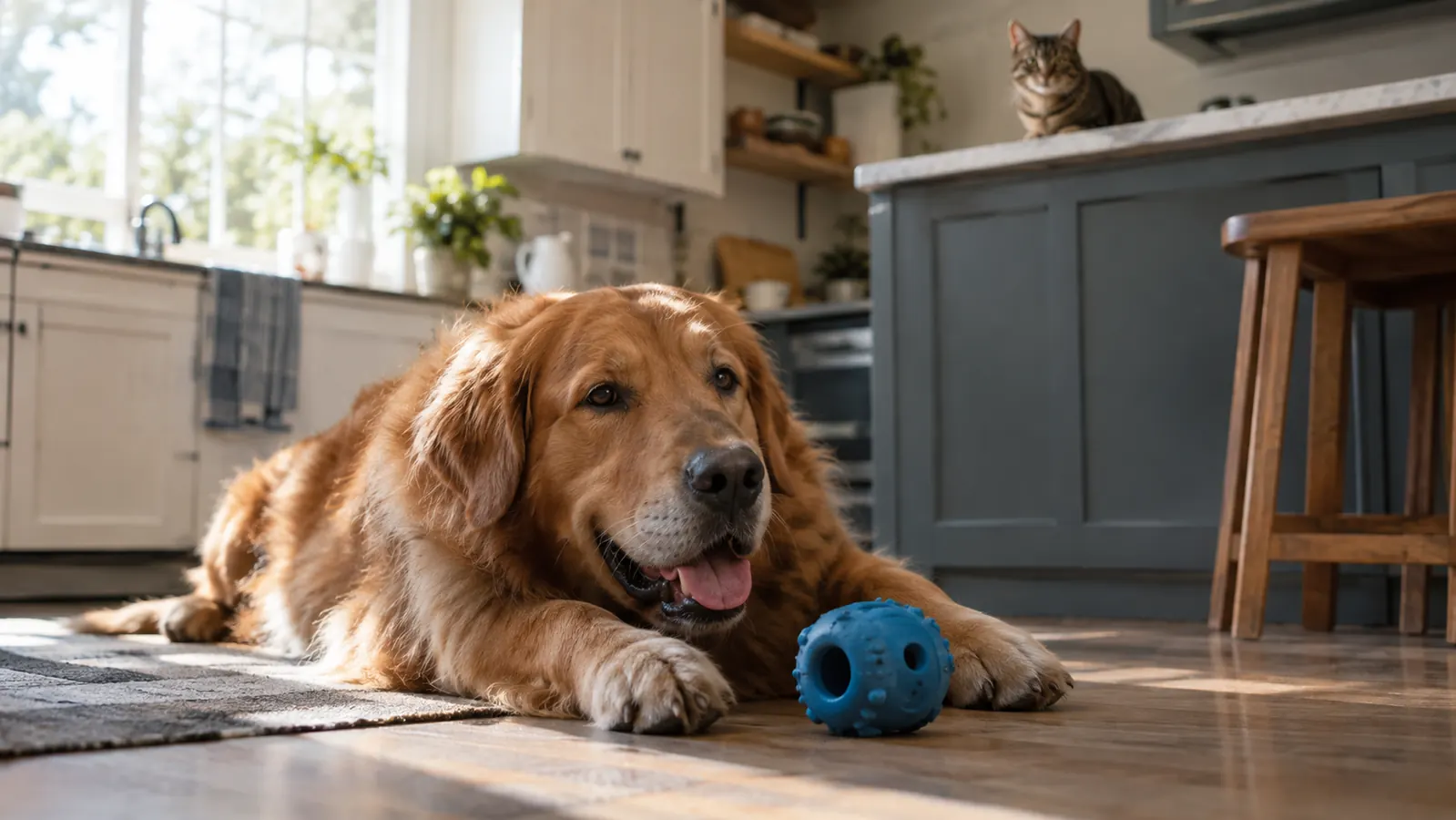
Biscuit, my seven-year-old shepherd mix, used to eat my house one afternoon at a time. Not the furniture, exactly, but the corners of it: a kitchen towel, the edge of a rug, one very expensive flip-flop that I found in three pieces on the porch. He is sixty pounds of shed fur and a fast eater, and when he is bored he does not nap. He redecorates. It is January in central Illinois, which means the backyard is a frozen mud pit and a long walk requires three layers and a pep talk. I tried longer walks, more fetch, a second round of training, even a puzzle toy that he solved in eight minutes and then used as a pillow. All of it helped, and none of it filled the hours when I was busy making dinner or paying bills or folding laundry that he was, at that exact moment, un-folding. What finally worked was the simplest thing in the house: a KONG Classic, a stuffable natural rubber toy, and a little time spent filling it the right way. This is how I stuff one for Biscuit, and how the filling, the freezing, and the cleanup actually work in a real home with a shed-happy dog and a cat who supervises from the counter.
The first KONG I ever bought came with good intentions and no plan. I stuffed it once with a spoonful of peanut butter, handed it over, and watched Biscuit finish it in four minutes. Four minutes. The toy was fine, the filling was gone, and I was back to square one with a dog who now expected peanut butter on demand. The difference between a KONG that buys you ten minutes and one that buys you an hour is almost entirely in how you layer it and whether you freeze it. The good news is that the whole routine takes about five minutes of prep once you know the order. The steps below are the order I have landed on after months of trial, error, and one incident involving pumpkin on the ceiling.
Start with a KONG that fits your dog
The KONG Classic in the large size is the one I reach for with a sixty-pound dog: natural rubber that springs back from heavy chewing, and a hollow middle that holds a filling and gives it back slowly. Check today's price on Amazon and have it ready before you mix your first batch.
Amazon Check Today's Price on Amazon →Step 1: Start with a clean KONG and the right size
The very first thing I do is wash the KONG. I know it sounds fussy, but a new KONG has a factory smell and a slightly dusty surface, and Biscuit would rather sniff it suspiciously than eat out of it. I wash mine in hot soapy water, rinse it well, and let it dry completely. The rubber is dishwasher safe on the top rack, which the package says, but I find hand washing easier because I can check the inside with a finger for any leftover bits from the last round.
Size matters more than people think. The KONG Classic comes in several sizes, and the large size is the right one for Biscuit. A too-small KONG can be pushed to the back of the mouth, which turns a treat into a choking risk, so I size up when I am in doubt. A too-big KONG is just awkward for a dog to hold onto. The large size has a hollow center that is big enough for a real filling, which is the entire point of this exercise.
One more note before we start filling: I keep two KONGs in rotation. That way one is in the freezer while the other is being used and washed. If you only have one, you will find yourself waiting for it to thaw or dry at exactly the wrong moment, usually while your dog is staring at the fridge. Two is the difference between a routine and a scramble.
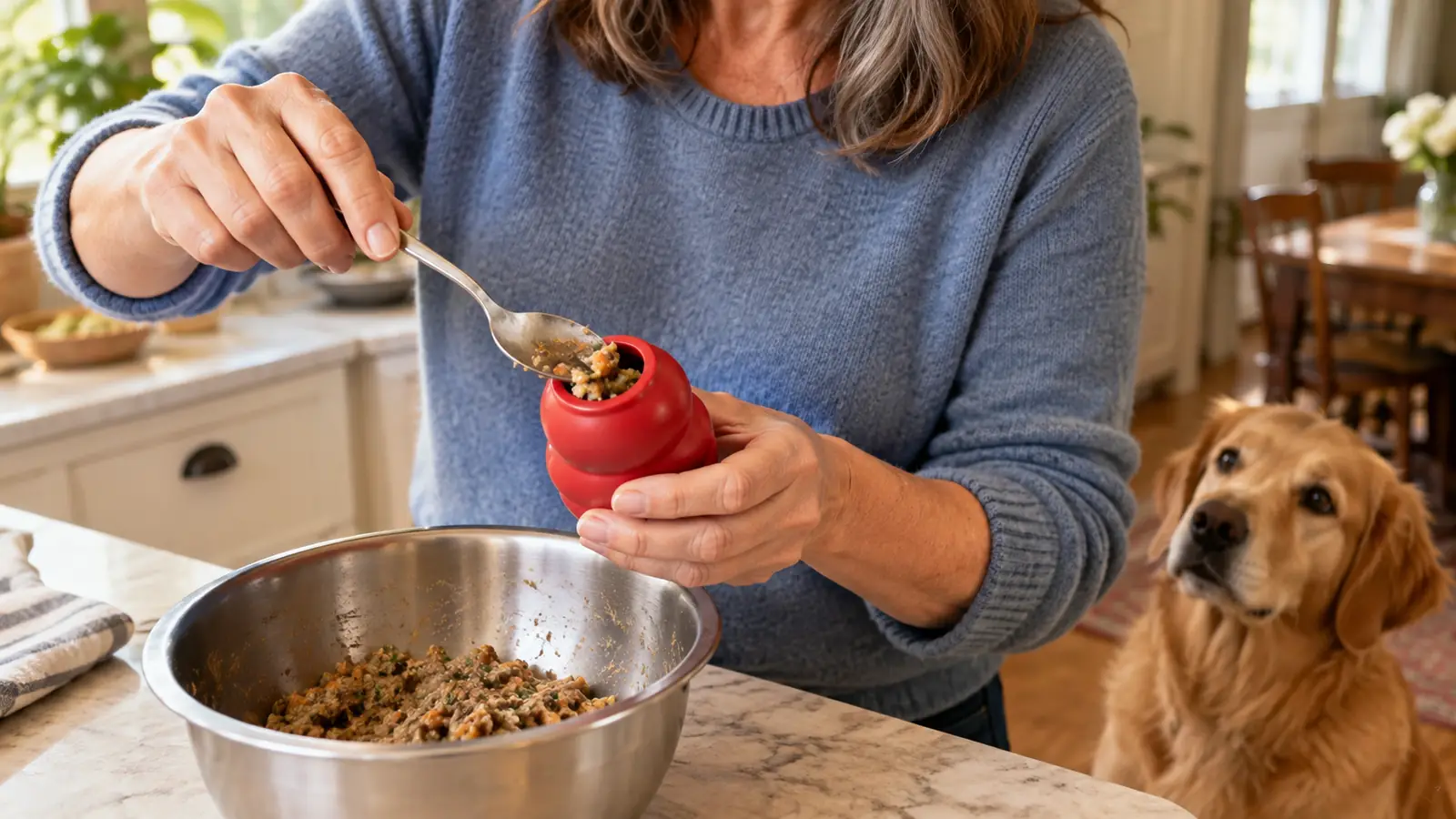
Step 2: Plug the small hole so nothing drips out
Every KONG has a small hole at the narrow end. If you skip this step, your filling will slowly ooze out onto the floor, and your dog will finish the job in a few minutes while licking the carpet. I plug the hole with a smear of something sticky: a little peanut butter, a bit of cream cheese, or a mashed banana. Just enough to seal it, not enough to count as a treat on its own.
The plug does double duty. It keeps the middle layers from leaking, and it gives your dog the first reward in the first minute, which is what keeps them interested in the project. I press the plug in with my thumb and then run a spoon around the inside to smooth it. If I am freezing the KONG, the plug also stops ice from forming a block at the small end, which makes the whole thing impossible to lick.
I will say the obvious thing here: check with your vet before introducing new foods, especially if your dog has allergies or a sensitive stomach. Biscuit does fine with peanut butter, but I buy the kind with no xylitol, which is toxic to dogs. I look for plain, unsweetened peanut butter with one ingredient: peanuts. Same rule for everything else I stuff in. When I am not sure about a food, I ask first.
Step 3: Layer in the middle, the part that holds the fun
The middle layer is where you decide how long the KONG lasts. For a quick win, I use something soft and spoonable: plain yogurt, canned pumpkin, wet dog food, mashed sweet potato. These spread easily and freeze well. I pack them in with a spoon and push them down so there are no air pockets. Air pockets are the enemy, because they let your dog get at the filling too fast and they leave a disappointed dog holding an empty toy.
For a longer challenge, I mix the soft stuff with something chunky: a few pieces of kibble, a broken-up training treat, a slice of banana. The dog has to work around the chunks, which slows everything down. I have also stuffed small bits of carrot and green bean in there, and Biscuit treats them like buried treasure. The chunks do not need to be fancy. They just need to be small enough that he cannot swallow them whole.
Here is the honest part: there is no single right filling. The right filling is the one your dog will actually work for. Pepper, our indoor tabby, watches the whole operation from the counter and would like you to know that none of this interests her, while sitting directly on the bag of catnip. I ignore her and pack the KONG tight. A loosely packed KONG is a short-lived KONG, and I have learned that lesson more than once.
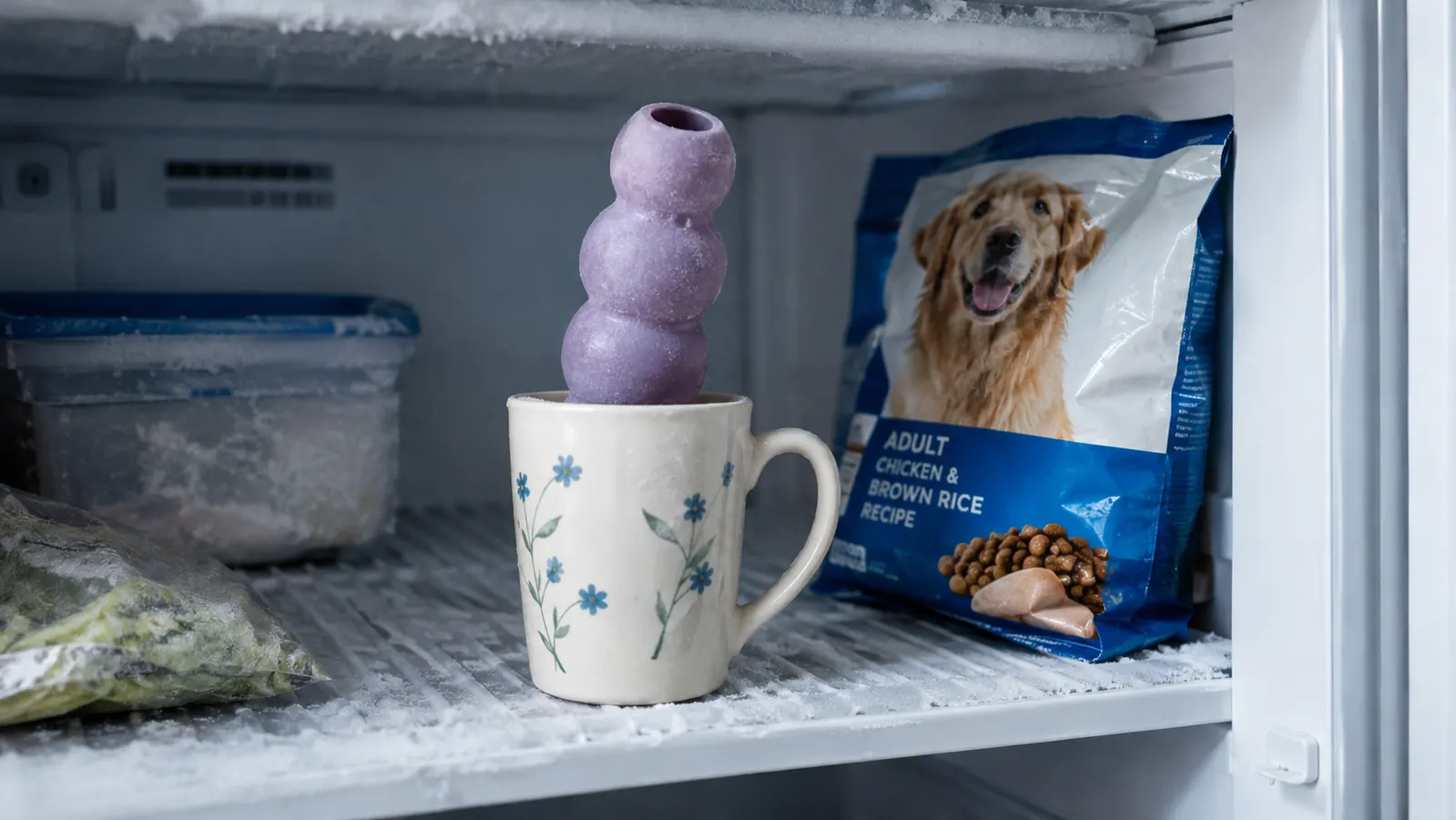
Step 4: Cap it with a freezer layer for the long game
The top layer, the one nearest the wide opening, is the one that makes the difference between a ten-minute KONG and a forty-minute KONG. I cap the filling with something that freezes solid: a scoop of peanut butter, a little plain Greek yogurt, or mashed banana. I smooth it across the top so it seals the softer middle in. This is the layer that turns a snack into a project.
Then I stand the KONG upright in a mug or a small bowl and put it in the freezer. The upright position matters. If you lay it on its side, the filling can run out before it freezes, and you will open the freezer to find a mess and an empty KONG. I freeze for at least three hours, usually overnight. The frozen cap means your dog has to lick and chew their way through the cold layer before they ever reach the good stuff underneath.
You do not have to freeze it every time. On a normal afternoon, I give Biscuit an unfrozen KONG for a gentle twenty minutes of licking. When I need a solid block of quiet, during a phone call or while I am making dinner, the frozen version is the one that buys me time. Think of freezing as a dial, not a rule. Start unfrozen, see how long it lasts, and turn the dial up when you need a longer pause.
Step 5: Serve it safely and clean up after
I give Biscuit his KONG on the kitchen floor, where I can see him, and I do not leave him alone with it the first few times. Most dogs chew a KONG the right way, but some try to bite chunks off the rubber itself, especially when the filling is gone and they are frustrated. The KONG Classic is made of tough natural rubber, but no toy is indestructible, and I would rather supervise than guess. When he is done, I take it back before he starts gnawing the empty shell.
I scrape out the leftovers and wash the KONG before the next use. Leftover filling dries into a crust that is miserable to clean, so I rinse it right away. I also check the rubber for cracks or bite marks after every few uses. A worn KONG goes in the recycling, not back in the freezer. If your dog is an aggressive chewer, the KONG Extreme line is built tougher for heavy jaws, and I would point you there instead of pretending the Classic will last forever.
One last serving note: the KONG is a tool, not a meal. I count whatever I stuff into it as part of Biscuit's daily food, because a frozen KONG stuffed with wet food and peanut butter can easily be a few hundred calories. When I am not sure how much is too much, I ask my vet. A bored dog is a fixable problem. An overweight dog is a harder one, and the stuffing is supposed to help, not hurt.
What Else Helps
The KONG is the backbone of my boredom plan, but it is not the whole plan. Biscuit also gets a walk before I leave the house, because a tired dog is a less bored dog. I rotate his toys so the ones in the basket are not always the same ones, and I hide a few pieces of kibble in an old towel for him to sniff out. Mental work wears a dog out faster than physical work, and a KONG is mental work with a food reward at the end.
Pepper gets her own corner of the house with her own bed, because a dog with a frozen KONG can be a lot for a cat who values personal space. The two of them have worked out a system: Biscuit eats his KONG on the kitchen floor, Pepper watches from the counter, and nobody steals anybody's dinner. That counts as peace in our house.
If your dog is destroying things, check the basics first: exercise, attention, and whether they are getting enough mental stimulation. The KONG is a wonderful helper, but it will not fix a dog who needs more walks or more time with you. And if the chewing comes with other signs, like pacing, hiding, or not eating, ask your vet. I am not a vet. I am just someone who learned to stuff a KONG so my flip-flops would survive.
A frozen cap turns a ten-minute snack into a forty-minute project, and that is the whole difference between a bored dog and a busy one.
Give your dog a project instead of a problem
One KONG Classic in the large size, five minutes of layering, and a night in the freezer. It is the cheapest boredom fix I have found, and it works on a sixty-pound shepherd mix who used to eat flip-flops. Check today's price on Amazon and start your own routine tonight.
Amazon Check Today's Price on Amazon →